

Understanding the Observer Pattern in JavaScript

Introduction
The Observer Pattern is a behavioural design pattern that allows objects (observers) to subscribe to events and react when those events are triggered. It is widely used in JavaScript for event handling, pub-sub mechanisms, and state management solutions like Redux.
In this blog post, we will explore the Observer Pattern with a practical JavaScript example.
What is the Observer Pattern?
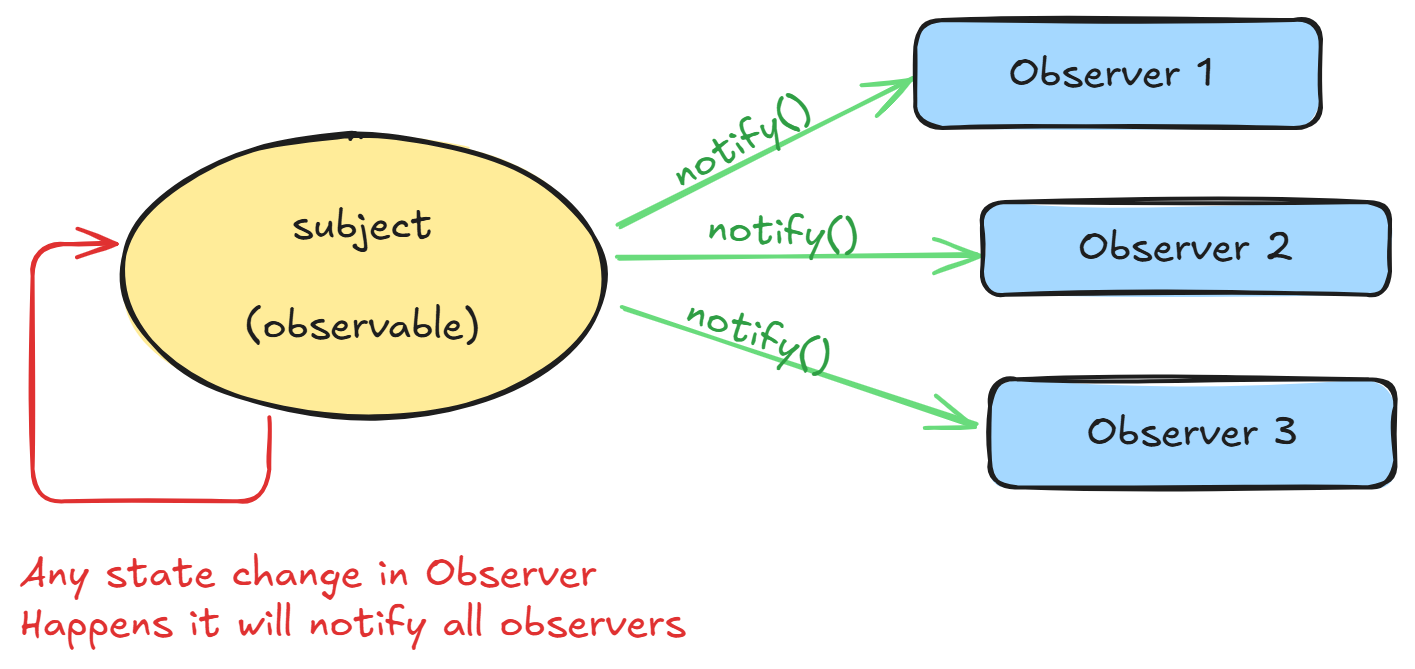
The Observer Pattern consists of two main components:
Subject (Observable): Maintains a list of observers and notifies them of any state changes.
Observers (Subscribers): React to changes when they receive notifications from the subject.
This pattern promotes loose coupling, making the system more scalable and maintainable.
Implementing the Observer Pattern in JavaScript
Let's implement the Observer Pattern using an EventObserver class.
Code Implementation
class EventObserver {
  constructor() {
    this.handlers = new Set();
  }

  subscribe(fn) {
    this.handlers.add(fn);
  }

  unSubscribe(fn) {
    this.handlers.delete(fn);
  }

  fire(o, thisObj = null) {
    this.handlers.forEach((handler) => handler.call(thisObj, o));
  }
}

// Usage
const event = new EventObserver();

const observer1 = function (data) {
  console.log("Observer 1:", data);
};

const observer2 = function (data) {
  console.log("Observer 2:", data, "Context:", this);
};

// Subscribing observers
event.subscribe(observer1);
event.subscribe(observer2);

// Firing event
event.fire("Event Fired", { customContext: "Hello" });

// Unsubscribing observer1
event.unSubscribe(observer1);

// Firing event after unsubscribe
event.fire("Event After Unsubscribe", { customContext: "Hi" });
Explanation
Creating the
EventObserverclass:Uses a
Setto store unique handlers (observers).Implements methods for subscribing (
subscribe), unsubscribing (unSubscribe), and notifying (fire).
Subscribing observers:
observer1andobserver2are functions that log event data.Both observers are added to the
EventObserverinstance.
Firing an event:
The
firemethod triggers all subscribed observers with event data.observer2also receives an optionalthisObjcontext.
Unsubscribing an observer:
observer1is removed usingunSubscribe.Only
observer2reacts to the next event.
Benefits of the Observer Pattern
Decoupling: Observers and subjects are loosely connected, improving modularity.
Scalability: New observers can be added dynamically without modifying existing code.
Flexibility: Can be applied in event-driven architectures, UI event handling, and real-time data updates.
Pros and Cons
Pros
Promotes Loose Coupling: Reduces dependencies between components, improving maintainability.
Extensibility: New observers can be added at runtime without modifying existing code.
Efficient Event Handling: Useful for implementing event-driven architectures and reactive programming.
Improved Code Organization: Helps structure complex event-driven systems logically.
Cons
Potential Memory Leaks: If observers are not unsubscribed properly, memory usage can increase unnecessarily.
Unpredictable Execution Order: Since multiple observers respond to events, execution order may vary.
Debugging Complexity: Difficult to trace event flows, especially in large-scale applications.
Overuse Can Lead to Complexity: Excessive usage may result in a highly decoupled system, making it harder to track dependencies.
Real-World Use Cases
Event listeners in JavaScript: DOM event handling (
addEventListener,removeEventListener).State management libraries: Redux follows similar pub-sub principles.
WebSockets & real-time applications: Observers receive real-time updates.
Conclusion
The Observer Pattern is a powerful tool in JavaScript, helping developers manage event-driven systems effectively. Understanding and implementing this pattern can greatly improve the maintainability and scalability of your applications.
Try implementing this pattern in your projects and explore how it enhances your code structure!